Tuesday, October 15, 2013

Sore feet and mountain sunrise

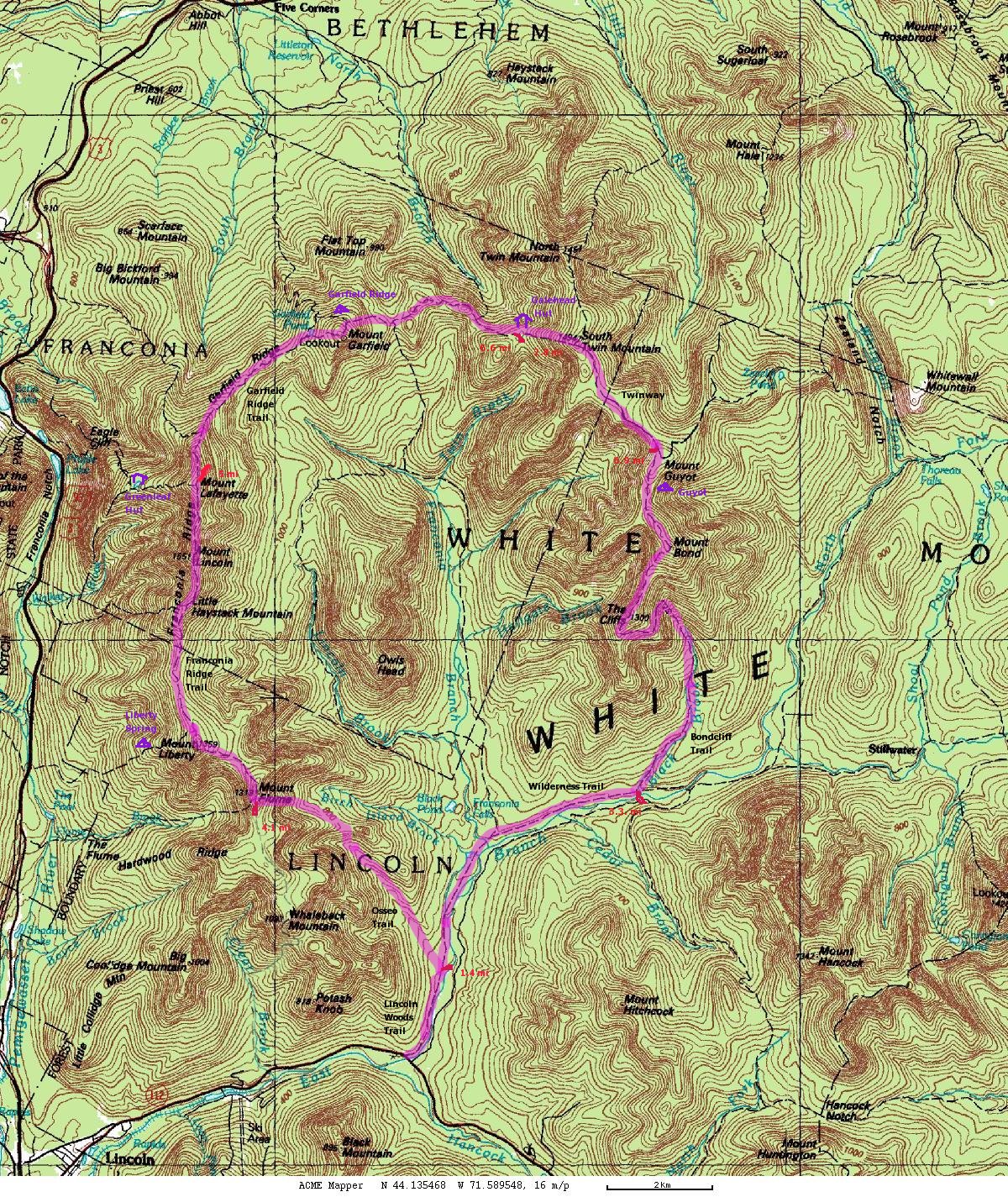
What's your favorite plan for a fun, relaxing four day weekend? Thanks to awesome MITOCer (MIT Outing Club) Sally, I ended up with the rather terrifying plan to do a one-day Pemigewasset traverse. On paper, this looks like:
  •   53 km of trail, with
  •   6 km of vertical (half up, half down)
  •   9 summits
  •   a lot of rocks to step on
So I spent a lot of time in the gym for the preceding few weeks, and ate a lot of fattening things, and prepared myself to be completely destroyed. It didn't help to realize that Backpacker Magazine lists this as the second-hardest day hike in America.

Of course, it feels pretty awesome now that I'm sitting at home at MIT eating a late-afternoon breakfast and putting my feet up, with a solid hike and five new 4000-footers under my belt: the conclusion of the this story is yes, we made it.

Having driven up north the night before, at 4am we headed out of the Lincoln Woods trailhead towards our first summit of the day: Mt. Flume. Hardly a word was spoken, and I can't imagine any of us was much awake those first two hours. Around us fell mist and clouds, thicker and thicker as we pushed upwards, until my headlamp blazed to illuminate a few feet of water droplets ahead of me. Partly afraid of losing the trail, but mostly in the hopes of sparing us fatigue by the end, I kept our pace just slow enough to keep my breathing even. We would manage to sustain this sleepy 3mph for about the first third of the trip.

Stars! calls out Sally. Suddenly, time is moving, space is opening up above us, and the ceiling is lifted from our little tunnel of mist and endless footsteps. We're getting higher, so when we turn off our headlamps for a few moments to watch the light peek at us through leaves and clouds we might just glimpse the shadows of mountain ranges lifting around us. After that, things go quickly. We climb on, up rocks and a few sets of manicured wooden stairs, passing better and better viewpoints as the mist gets thinner, the sky paler, and the surrounding mountains more visible through the trees. 'This is the start of my first full, clear mountain sunrise', I think, and it's electrifying.

The competition for the most glorious sight of my life is wonderful and fierce, but this hour - from the first glimpse of stars to the stunning climax of Mt. Flume - surpassed all expectations. I thought I'd seen my fair share of sunsets, and passed meditative morning hours in the valleys watching the sun strike ridge after ridge in the distance, but now I see why it's the sunrise for which mountaineers and photographers submit themselves to summit camps and alpine starts. The air is still clear, and we see that the clouds did not dissipate: we surpassed them. The sky is orange; the last stars still linger; and below us is a rolling white cloud sea. Nothing is visible above but the mountains, with mist running down their slopes into the ocean. We were on Flume for a few chilly, thrilling moments before descending towards Liberty.

Photo: Sunrise at the start of an awesome 18:06 pemi loop! Let's see if next weekend I can shave an hour off
If I were to do this again, I would have started earlier and made it truly above treeline in order to draw out the sunrise, but nonetheless the weather stayed beautifully clear, the trail near deserted, and the valleys below us mesmerizingly cloud-covered until we ascended Mt. Lafayette. This was our fourth summit (after Flume, followed by Liberty and Lincoln which we passed quickly) and the highest, and rather full of tourists.
Stopping on the summit of Mt. Flume - Photos thanks to Tyler
If we weren't tired, we were by this point at least conscious of the miles behind us. We made slower time on the three mile descent from Liberty (another great reason not to do the loop the other direction!), and then on the bumpy, rocky route to Mt. Garfield, filling up on water at Garfield Pond. Still, it was quite fun to finally hit the peak and announce it as our fifth summit! After Garfield was a quick jaunt to Galehead Hut, our halfway point where thanks to the AMC we had a long and caffeinated break before what we gratefully realized would be our final steep ascent of the day up to South Twin. 

In my experience, hiking is an essentially solitary activity. This doesn't reflect negatively on other people; meeting someone in the mountains creates and instant bond of friendliness, and the hiking community has an incredible way of attracting like-minded and wholehearted people. However, serious hiking ultimately requires you to immerse your mind and body in the mountains around you. It invites both physical challenge (like Pemi loops...) and deep introspection. Sometimes this is because the wild beauty around you will sweep your heart up with the wind, and sometimes because it's the only way to draw out enough of your reserves to make it home.

So, Sally and Tyler introduced infuriating guessing games on the way across the Bonds to try to forget about our footsteps for a few miles. We dreamed together about hot chocolate, baths and bed. Sally and I went out of our way to tag West Bond (summit 7!), leaving our packs and taking the extra mile at a jog, which felt fabulously energetic. We wound our way to Bondcliff across rocky slopes dotted with tiny alpine trees and bright berries, until amidst evening clouds that obscured what might have been a stunning view of the wilderness, our group stretched thin. Alone with the moss and the stones I felt the mist swirl intimately around me. Tired, blistered; how could I feel less than love for these mountains? I gave them quite completely my body, and they left me thrilled enough to run and happy enough to hunt wildflowers with my eyes. 

There is little to say about the last ten miles after sunset, except that they felt far longer than I can convey in brief words. The descent tired my knees and ankles painfully at every step until the final flat had the chance to tire my feet and bones. Tyler went ahead of us old ladies so he'd have a chance to nap in the car before driving, and the rest of us made the last five miles by singing children's songs and Simon and Garfunkel and anything our minds were straight enough to remember the words to. Nonetheless, we made it. We were back at the car just in time for the clouds to leave us again with a sky full of stars.

Saturday, June 8, 2013

There Might Be Bears

Well, this is embarrassing. I’m hiding behind a broken concrete wall, letting my rather muddy dog take an afternoon nap while I take the chance to strip down to my sports bra, spread my clothes out to dry in the sun, and curl up barefoot on my backpack eating squished bread and tuna. It’s a peaceful chance to sunbathe – at least until a rather rugged man pulls up his pickup truck in the grass, not ten feet from me, and tries to turn it around. Oops. Should I grab for my clothes? Yell an apology?

Nope. Just another hobo, he thinks, and drives off without a second glance.

 ***

It was a few weeks ago that I first had the brilliant idea of leaving behind my end-of-semester stress and taking some time by myself to think. I’ll take myself backpacking, I thought, I love hiking, it’s a perfect excuse not to do any work or check my email. I’ll do 100km or so for a little challenge. West Virginia isn’t thatmountainous, right?

What I ended up doing was a fragment of something called the Allegheny Trail - accompanied, by the way, by my dog Fei, who has almost forgiven me for taking him on a never-ending-walk. It stretches some 330 miles through the Appalachians, and is the brainchild of a group of hikers who decided that if West Virginia didn’t have any long-distance trails, they would make one – an awesome attitude. However, the trail is new and little-known enough that my time went something like this:

West Virginia is wild...
wasting...
wonderful.

Paved Roads: walk along two-foot wide verge while locals drive by at 55mph. Be impressed by how quickly dog learns to get off the road and sit still when he sees a car coming. Be unimpressed when dog learns to dive under the guard-rail and away into the bushes when he sees a truck.

Jeep Trails:  in some places I could go miles without seeing a house or person, and they were easy walking with lots of little streams and butterflies.
Can you see the tail of our
explorer of shrubbery?

Footpaths: these were entirely un-maintained. I came to dread them. I fended off spiders with a stick and every few paces in the name of public service to throw aside trees and branches that had fallen into the path (Dog collected small sticks and had great respect for my tree-tossing prowess). Still, at many points we had a great time as jungle-explorers and bug-hunters extraordinaires.

The most spectacular path appeared on the morning of the last day, and looked like this:


Picture an obstacle course, where you have to climb over things and army-crawl under things and push through things while balancing on narrow branches. The re-picture it with a forty-pound pack on your back, and no ideawhether it goes on for four more yards or four more miles.

When I finally made it through onto semi-populated roads, a guy in a little Honda stopped me.
‘Did you just come up Twelvemile Run?’ he asks.
‘Yes,’ I said, ‘did I ever.’
‘Do you think I could get my car through there?’
I told him it might not be the best of ideas. 
Naptime.
***
The final big adventure was camping. I’ve camped in the wild before, but always with a tent and some company. I brought some rope and a hammock and tarp, an intention to just pick some good-looking trees in places no one would bother me, and a lot of warnings about… bears.

Bears aren’t so bad, right? They eat lots of things that aren’t people. They don’t even like people. You just have to hang up your food in a tree, far enough away that a hungry bear can try to get it without having to go through you. Then, having hung your food, you stumble back to your hammock by flashlight, right towards a set of glowing eyes in the dark. Boy, did I wish I’d discovered this about my dog beforehand.

Afterwards, you can wrap up in your sleeping bag and slowly doze off, glad that your dog has good night-senses if anything comes. You can keep trying to slowly doze off while he cocks his ears in one direction and growls. And keeps growling, and growling towards this one patch of trees; not a bark, as he gives to anything he thinks he can scare, but a continuous menacing growl at the dark. I can see nothing. He keeps growling. I make mental plans about which way to retreat in case of bears. Dog keeps growling. I wish I could just sleep so that whatever is out there can eat me and get it over with. Dog keeps growling, until finally it starts to rain and everything becomes still. 
Home Sweet Hammock

The nights were beautiful, too. There’s something special about camping in a hammock on a clear night, where you can open your eyes in the night and look straight up at the stars. The last night, we stumbled on a spot that looked like a caravan campsite; a lovely riverside clearing a mile from anywhere. It was still early when we got there, so I spent a while setting up my lean-to in case of rain, then sat and watched the sunset over the tree-tops. At dark, the clearing filled with fireflies. 
The moment, after three long days, was perfect.

That last day, I loved the coolness of the rain and the drops on my head. Then I hated the endless rain. I hid from it under a tarp by the roadside full of the smell of wet dog. I rested from it sitting on mud of its making. Then I found, finally, a patch of sunlight winking through the leaves, and came out into open farmland, with a view over waving grass to the rain falling on valley after valley as the Virginia hills stretch blue into the distance.

- What did I find here, I asked myself, that I was looking for?
- I found how to keep going; that it doesn’t matter whether it’s rainy and your feet hurt.
- You learned a little bit more about sore feet? That took you four days of bruises, filth and getting mistaken for a hobo? After spending all semester wishing for the time to properly learn statistical physics?
- Yes. Physics is less important than feet.

Sunday, November 4, 2012

Espresso, Peppermint tea - and Peanuts

Tea is lovely (although I do prefer coffee). Following the example of Laura, I have to confess to my own food-related obsession: Peanuts -- or rather, peanut butter.

Illustration: during my stay in Leipzig this summer, I spent one caffeine-dazed afternoon writing a full-length article on the subject. I think you might be interested. Be forewarned: it is supposed to be a kind of pretend-pretentious exposé about the product (oh, and Kelly - the American in the article is an Ohian friend of mine at St John's. She's great, and also a vegetarian!):


"My ultimate student recipe:
Step 1) Take peanut butter. Step 2) Eat. Repeat as necessary.

It is a fact well-known that different countries have different foods. Hailing from Sweden
(apparently the land of painted horses and self-assembly furniture), I am accustomed to
certain culinary peculiarities. Fermented fish (surströmming) is one. Pickled herring (sill) is
another. It seems Swedes want their fish to be more than just fishy. For, say, the
Mediterranean Italian, accustomed to fresh and (typically) only lightly sautéed catch, this may
seem an odd preference. I do not blame them.

I was once equally unfamiliar with, and perplexed by, peanut butter – this most
quintessential of American foodstuffs, to which this essay is dedicated. In the spirit of
Melville’s exhaustive writings on the subject of whales in Moby Dick (1851), I shall rise to
the challenge set forth by him in that book: “To produce a mighty book [or essay, I assume],
you must choose a mighty theme. No great and enduring volume can ever be written on
the flea, though many there be who have tried it”. He was here referring in part to the
mighty physical bulk of his object of study. In this sense my endeavour to produce even a
passable essay seems doomed – what is the modest peanut (incidentally a legume rather than
a nut, giving even its name less umph) compared to the vastness of the whale? I seek refuge in
what I take to be the second meaning of “mighty”; a cultural bulk rather than a physical one.
For peanuts – roasted, ground, and mixed into butter – surely stand out as the most
fundamental staple food of the American childhood. Is not peanut butter to the American,
then, what Madeleine cakes were to Proust? What could carry a mightier cultural significance,
at least from the point of view of the individual?

I cannot pretend to be an expert on the subject, as I have not grown up in the US (nor spent
any more than a hectic two weeks in the country when I was thirteen). The purpose of this
essay is therefore to show that peanuts, and in particular peanut butter, are interesting also for
the non-American. Many are the occasions when it has saved the lives of individuals (more on
that later), and many are the cuisines apart from the American one it has enriched.

But let us start with the American way of consuming the product. My first exposure to peanut butter, when I was around seven, came as a side effect of
a nostalgia trip. We were living in England at the time, and my father had bought a jar of
Skippy’s from the local Sainsbury’s. His purpose was to consume it the way he’d learnt to as
an exchange student in California of the early 70s. Generous servings of peanut butter, white
toast and, of course, jam. My brothers were enthralled. I was not as sure. I found the peanut
“butter” more akin to a paste that stuck to the palate of my mouth, rendering sophisticated
verbal communication impossible (this did not trouble my brothers, who were busy producing
delighted “mm”-sounds that do not need much phonetic elaboration). The jam (blackcurrant –
my grandmother’s), moreover, was runny and stained my fingers purple.

As you will have noticed, my first experience of peanut butter was in the iconic American
“peanut butter jelly”-format (only slightly perverted by the Swedish-style jam we used), and I
did not like it. In hindsight, I realize it was the taste of the peanut butter together with its
accessories that disagreed with me, rather than the peanut butter itself. So even though the
concept of “peanut butter jelly” sandwich holds a very special place in American popular
culture (as evidenced by the fact that this dish was my dad’s most nostalgic memory from his
time in the US), I’d like to begin my defence of peanut butter by emphasising that there are
alternative ways in which to consume this product.

It was not until I came to Oxford that I had this insight, when an American friend
enlightened me that peanut butter sandwiches need necessitate neither jam nor white toast. As
a child, my friend used to enjoy sandwiches with peanut butter on top of normal dairy butter.
A more recent innovation of hers is peanut butter with cheddar on whole meal toast. I can
attest that both combinations are delicious. Then there is the “Elvis Presley sandwich” (or just
“The Elvis”), apparently the favourite food of the eponymous and iconic American artist. It
includes peanut butter, banana and bacon. I have not tried this one, but I presume it’s a hot tip
for anyone wanting an alternative post-clubbing fry-up (yes, it is also usually fried. I know).
Finally, there’s my preferred way of consuming the substance – in the form of peanut butter
with bread rather than bread with peanut butter. It’s all about the ratios in my book.

We can thus begin to answer why peanut butter is interesting and worth eating also for non-
Americans.
Firstly, it is a tasty and versatile product. As stated above with the example of my friend, it
is not mandatory to consume peanut butter in the “peanut butter jelly” form. The product has,
in fact, enriched (literally and figuratively) the cuisines of many cultures. Have you ever
heard of, or better yet tasted, peanut sauce (also known as satay sauce)? This is used in many
Asian cuisines, notably the Indonesian (from where it has been imported to the Netherlands
during Indonesia’s period as a Dutch colony – nowadays French fries with peanut butter can
be enjoyed on the streets of Amsterdam). To be fair, peanut butter is not traditionally used in
most Asian recipes for satay sauce, which instead specify the use of ground roasted peanuts
(and I must add the disclaimer that peanut sauce has been around for longer than the
American version of peanut butter!). But in my mind ground roasted peanuts are pretty much
equivalent to what I would call peanut butter. And the end result is equally infused with the
excellence of peanuts in their processed form.

Secondly, peanut butter saves lives. One must, for example, recognize its worthiness as
student food. In my first Michaelmas at Oxford, I would have been reduced to bones were it
not for this high-energy substance. It’s not that I don’t like to cook/eat normal food. I do. It’s
just that Oxford sometimes comes in between. What better way to ingest calories, then, than
to do it with minimal preparation and maximum convenience? Even more importantly, the
simplest meals based on peanut butter have an amazingly low “dishes to satisfaction”-ratio
(yes I just made this ratio up, but when you think about it it’s a pretty useful way to score the
student-friendliness of a dish). If you do like to complicate life for yourself, you can always
make your own peanut butter – all you need are roasted peanuts, salt and a food processor (or
a plastic bag and a hammer, depending on how hardcore you are). I think you can figure out
how to proceed from there.

My own anecdotal experience of the nutritional value of peanut butter is empirically
founded in international development work. In 2006, French paediatrician André Briend
developed a product called Plumpy’nut, aimed at treating sufferers of acute malnutrition. This
is a 92-gram plastic package filled with peanut paste that has been mixed with a number of
other substances (e.g. milk powder and sugar) to further boost the nutritional content. For the
most severe types of malnutrition, two sachets per 5 kg of body mass per day are administered
over a period of 6-10 weeks. The product requires no preparation before consumption, is
relatively cheap to produce (much of the world’s peanuts grow in developing countries where
the incidence of malnutrition is greatest), and has been shown to be very effective at what it is
designed to do – making sufferers of acute starvation gain weight. There has, however, been
controversy surrounding the producing company’s, Nutriset’s, unwillingness to let go of its
patent and thus lower the cost of the product further. This does not diminish the role of
peanuts as the main ingredient in an effective (and apparently also quite tasty) treatment
against malnutrition.

Still, in our corner of the world, where excess rather than lack of calories is more common,
the wonders peanuts work against malnutrition may seem a disadvantage to consumers wary
of putting on pounds. I’d say – don’t worry. Firstly, it seems that consuming peanuts (high in
polyunsaturated fat, protein and fibre) makes people fuller and thus prone to consume fewer
calories overall. Secondly, there is evidence to suggest that incorporating peanuts in one's diet can give protection against heart disease and type II diabetes. Of course, consuming anything in excess can be harmful, and peanut butter is calorie-dense (particularly the sweetened kind). In moderation, however, it can be very healthy indeed.

Finally, peanuts were first recognized as edible by the Incas, who also gave us chocolate.
The raw material of the latter – cocoa – bears the telling genus name Theobroma, “food of the
gods”. Clearly these people knew what quality cuisine was. And so should you, after having
read this Melville-esque rant on the glories of peanut butter, in my mind the ultimate student
food. The succinct answer to why more people should eat it is, simply, because it is tasty,
nutritious and convenient. I hold no shares in peanut butter-producing companies. This
product is just objectively amazing.

(Apologies to those with peanut allergies. There’s still chocolate?)"


This obsession made me want to try making peanut butter of my own. When my Ohian friend came to visit me, I took the opportunity of putting my food processor to use:

                  This is the peanut butter. 


This is the sunflower seed butter we attempted to make. Clearly inferior. 


This is the peanut butter (to the left), and the sunflower seed butter mixed with peanut butter (to the right). The latter was actually really tasty, with the sunflower seeds giving the peanut butter an interesting depth of flavour that isn't normally there (perhaps a hint of bitterness?). Maybe there is a market niche to exploit here? ;)


Saturday, November 3, 2012

I ♥ Tea

Especially now that winter is desperately sneaking into the house through the old single glass windows... who doesn't love to warm up with a cup of tea?


I am a tea addict and I am not ashamed. A cup of heart-warming ginger and lemon tea is sitting right beside me at the moment.


It all started with chamomile tea. Sweet and subtle, makes me go back in time. My mom would prepare me a cup of chamomile tea everytime I was ill, along with a teaspoon of honey if I had a sore throat.


Limeflower came next, calming, for stressing times. Peppermint, to bright up your day and refresh your mind. Fennel, nettle, dandelion, ginger, rosehip... with herbal teas the options are infinite.


Back in Spain I often get told that my tea obsession is part of the British lifestyle conversion. I do admit that a cup of Earl Grey in a rainy day can always make me smile. However I much prefer oriental teas. Green teas: more delicately fragrant. Japanese Sencha and Jasmine are definitely within my favourites. Oolong tea is another special one, exotic and yet mild. Spiced Chai, Assam, black teas with brighter and stronger flavours.


Just part of my tea collection!


So just remember... Keep calm and drink tea!

Friday, October 5, 2012

Geology Rocks!


Dinner warming up, with mist adding
mystery to the campsite.
Now, in theory I'm a physics student, but the rest of the time I persistently wonder why I haven't chosen to study philosophy or run off to work in one of the National Parks, until I realise that I can't see myself living without science. Recently, however, all of these uncertainties have taken a new direction. I want to see the great outdoors, with one arm brandishing a notebook and with the other a handlens, chasing down Earth's mysteries, wild and free. I want to be a geologist.

So, to cut a long story short, last Thursday evening I found myself pulling out my hiking bag and packing in my tent and a lot of pencils in preparation for the fieldwork part of Introduction to Geology.

We drove to upstate New York, pitched our tents in the drizzle, ate soup and s'mores around the campfire, and got ready to go hunting fault lines across the state.


Looking upstream on the Canajoharie Gorge - you can
see how beautifully the water cuts across the shale.
Thanks to Matthew Joss for the photos.
One of my favorite sites was a steep gorge in the Canajoharie River. We were on a bed of shallow water, with a twenty metre cliff of shale towering above us - the kind of thing that would look like a rock climber's paradise were it not possible to break the layers of rock between your fingers. Shale is usually laid down in deep water, and a lot of people managed to find fossils of trilobites.
However, these particular walls had rusty patches seeping out between a few of the layers - one of them ended right at the level of the river bed, and tracing it along I found a gap, where between two layers of shale was nothing but ash. Volcanic ash. It crumbled when I poked it. An inch thick even after being crushed under so many tons of rock. Between two layers of mud landing on the sea floor, a volcanic eruption had taken place, spewing ash across what is now the peaceful, earthquake-free Eastern US. Estimating the age from the trilobites in the layers above it, I got to spend my Saturday morning poking 400 million year old volcanic ash.

Welcome to Espresso and Peppermint Tea

Welcome to Espresso and Peppermint Tea. 

The inspiration for our title, at the loveliest little cafe in Asturias.

We've all managed to stay a little bit connected beyond St. Clare's, and we've also all moved on from there to other wonderful and promising bits of life.

I'd like to invite all of you to sit down with a cosy cup of tea, keep up with old friends, and share with us some of the little things that make life special.

Museu Nacional d'Art de Catalunya, and Barcelona skyline
Tyra, Rebecca, Laura, Kelly and Chloe